Why does winding affect the quality of the transformer

As the basic equipment of power transmission and transformation, transformer plays a very important role in power industry. With the rapid and stable development of China's economy, the demand for electricity is increasing. Its demand is also increasing, the market prospect is very broad. In the context of the global energy crisis, it is necessary to produce more efficient transformers.
It is in this context that the standards of transformer manufacturing in Our country have been improved again and again, and the requirements for performance indicators have become more and more strict. Uhv transformers have two development directions: one is large capacity, the other is low noise. Besides the influence of structural design, the quality and economic and technical performance of transformer largely depend on the technical level of manufacturing process and manufacturing equipment. In order to meet the increasingly strict requirements of transformer quality and performance indicators, it is necessary to improve the technical level of transformer winding machine, so that it can produce transformers to meet the needs of national power development.
A transformer generally consists of an iron core, a coil, a casing and the necessary insulation materials. Transformer coils are generally divided into high voltage coils and low voltage coils. High voltage coils are usually wound with circular insulated wire, while low voltage coils are usually wound with flat insulated wire or foil. The winding of transformer coil is the core process of transformer manufacturing, which has great influence on the performance of transformer. It not only directly determines the overall size of the transformer, loss, weight and other main economic and technical indicators, but also directly affects the mechanical properties of the transformer, insulation performance, heat resistance and other main quality indicators.
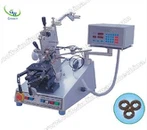
The traditional winding of transformer coil is based on the requirements of production process, relying on manpower to wind the insulating wire on the workpiece, and the operator calculates the resistance. The traditional winding method not only has low winding efficiency, but also the quality of finished coil is poor. At present, the winding of transformer coil usually adopts automatic winding machine, which can significantly improve the production efficiency and the precision of line arrangement. Among the automatic winding machines, there are vertical winding machines for winding large transformers, horizontal winding machines and winding machines for low-voltage low-capacity winding transformers.