


Transformer Potting Process: Common Problems and Efficiency Improvement Solutions
Meta Description: Learn the most common transformer potting problems, including low efficiency, uneven glue dispensing, pipeline clogging, and high labor cost. Discover professional dual-system potting solutions to optimize your transformer encapsulation process.
Introduction
Transformer potting (transformer encapsulation) is one of the most critical processes in electronic manufacturing. It uses epoxy resin, PU glue, or two-component adhesive to insulate, waterproof, and protect transformers and inductors. However, most traditional potting workshops still face many unstable and low-efficiency problems in mass production.
Many manufacturers struggle with high labor dependence, inconsistent potting quality, frequent machine clogging, and low production output. This article will analyze the core pain points of the traditional transformer potting process and introduce standardized industrial optimization solutions.
1. Common Problems in Traditional Transformer Potting Production
1.1 Heavy manual operation and high labor threshold
Traditional two-component potting requires workers to weigh glue proportion, stir evenly, and replace glue manually. The whole process relies heavily on skilled workers. Different operators often cause inconsistent mixing ratios, leading to defective products, bubbles, or incomplete curing.
1.2 Low production efficiency with single-station limitation
Most early potting equipment adopts a single-head design, which can only pot one product at a time. For large-volume transformer orders, factories need to purchase multiple machines and hire more workers, resulting in high workshop occupancy and high operating costs.
1.3 Uneven glue distribution and unstable quality
Some dual-station machines on the market share a single glue supply system. This shared structure easily causes unbalanced glue pressure, resulting in uneven glue volume between the left and right products. This leads to high rework rates in transformer mass production.
1.4 Complicated daily cleaning and high maintenance cost
After daily production, the mixing valve and fluid pipeline retain residual mixed glue. Without thorough cleaning, the glue will cure and block the pipeline. Traditional equipment requires manual disassembly, cleaning, and reassembly, which consumes a lot of maintenance time and delays production.
1.5 Pipeline curing and frequent equipment failure
During production standby or shift intervals, static two-component glue reacts and hardens inside the pipeline. Long-term accumulation causes blockage, unstable glue output, and even equipment downtime, seriously affecting production continuity.
2. Industrial Optimization Solutions for Transformer Potting
To solve the above industry pain points, automated dual-system potting technology has gradually become the mainstream solution for transformer manufacturing. The optimized process greatly reduces manual intervention, improves consistency, and doubles production capacity.
2.1 Zero manual glue batching (On-demand automatic proportioning)
Modern high-end potting systems support real-time on-demand glue mixing. The equipment automatically completes precise metering and mixing without manual weighing and stirring. This technology eliminates human error, ensures stable AB glue ratio in every batch, and greatly reduces defective rates.
2.2 Ultra-simple operation mode (Only loading and unloading required)
After process automation upgrading, the entire potting process no longer requires professional glue operation skills. Workers only need to place raw products and take out finished parts. The low-threshold operation effectively solves the problem of difficult recruitment and high worker turnover in traditional workshops.
2.3 Dual independent glue system (Solve uneven glue problem fundamentally)
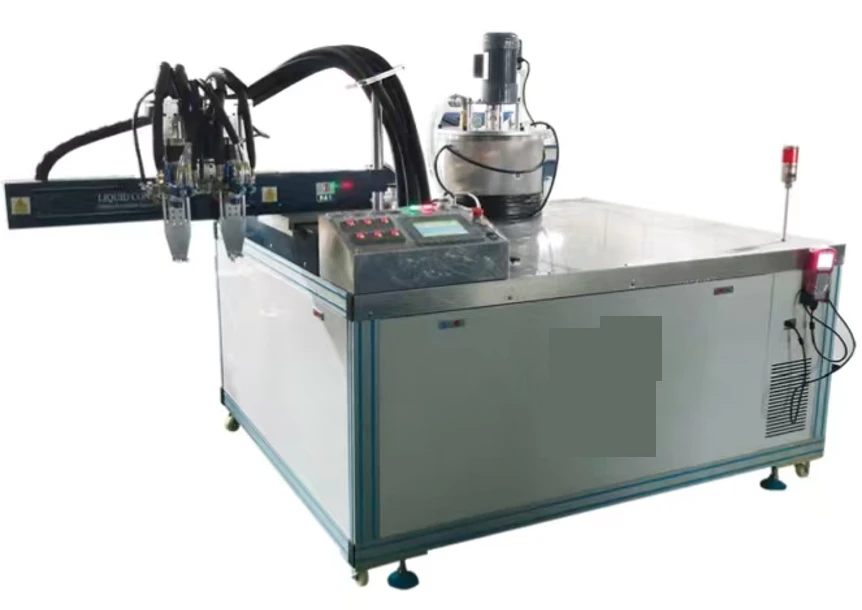
The most advanced industrial solution adoptstwo independent sets of metering and dispensing systems, instead of one shared system. Each working head has an independent pump body, independent flow path, and independent mixing structure.
This structural upgrade realizes synchronous potting of two products at the same efficiency of two machines. The completely independent delivery avoids pressure deviation and glue distribution imbalance, ensuring 100% consistent potting effect for each transformer.
2.4 Automatic cleaning system (Reduce manual maintenance)
Industrial-grade automatic cleaning function can flush the mixing chamber and internal pipeline with one click. No disassembly of accessories is required. It completely solves the problem of difficult cleaning of traditional potting machines, greatly shortening daily maintenance time and improving equipment utilization.
2.5 Pipeline anti-curing technology (Avoid blockage failure)
Professional anti-curing and anti-blocking design for standby state can effectively prevent two-component glue from reacting and solidifying in the static pipeline. This technology greatly reduces equipment failure rate and supports long-time continuous mass production, which is very suitable for transformer batch production workshops.
3. Single-head vs Dual-independent System Potting Process Comparison
|
Process Item |
Traditional Single-head Potting |
Dual Independent System Potting |
|---|---|---|
|
Manual Glue Mixing |
Required, high error rate |
Fully automatic, no manual operation |
|
Single Batch Output |
1 product |
2 products, double efficiency |
|
Glue Uniformity |
Easily uneven |
High precision, zero deviation |
|
Daily Cleaning |
Manual disassembly required |
One-click automatic cleaning |
|
Pipeline Blockage Risk |
High |
Low, anti-curing protection |
|
Labor Cost |
High |
Greatly reduced |

4. Application Industries of Optimized Transformer Potting Technology
This high-stability and high-efficiency potting process is widely used in mass production of:
Power transformers and power inductors
New energy power supply components
Industrial control electronic transformers
Household appliance insulation encapsulation parts
5. FAQ About Transformer Potting Process Optimization
Q1: Why does dual-station potting have uneven glue output?
Most low-cost dual-station machines share one glue supply system, resulting in inconsistent pressure on both sides. The fundamental solution is to adopt two fully independent metering systems.
Q2: How to solve frequent pipeline blockage in potting machines?
Pipeline blockage is caused by static curing of two-component glue. Equipping anti-curing protection and automatic cleaning function can completely solve this industry problem.
Q3: Can automatic potting process reduce the defective rate?
Yes. Automatic proportioning and independent metering eliminate manual errors, making the potting dosage and mixing ratio highly stable, which significantly reduces rework rate.
Conclusion
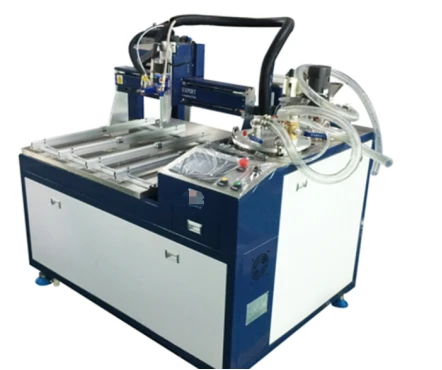
With the continuous upgrading of electronic manufacturing standards, traditional manual and single-head potting processes can no longer meet the requirements of high-volume, high-precision transformer production. The dual independent system automatic potting process has become the mainstream industry trend by virtue of low labor dependence, stable quality, double efficiency and low maintenance cost.
Manufacturers who want to optimize production lines and reduce comprehensive production costs can take dual-system automatic potting technology as the preferred upgrading solution.


