


1. Introduction
In today's rapidly evolving electrical manufacturing landscape, the transformer winding machine has emerged as a critical piece of equipment. As global demand for transformers grows - driven by renewable energy deployment, electric vehicle (EV) infrastructure, power grid upgrades and miniaturised electronics - the machines that wrap conductive wire into transformer coils are under the spotlight. These machines are no longer just mechanical winders: they are increasingly automated, digitally monitored, versatile and precision-tuned. This article explores the categories of transformer winding machines, their advantages, the market context and key considerations for manufacturers and purchasers.
2. Categories of Winding Machines
2.1 Basic classification by winding type
Winding machines can be grouped according to the geometry and application of the coils they produce. One broad category includes machines dedicated to bobbin winding, where wire is wound on a bobbin or former to form a primary or secondary coil of a transformer. Another category is toroidal winding machines, which wind wire around a toroidal (ring-shaped) core. As noted in coil-winding technology literature, toroidal core winding machines are used when low leakage flux, compactness and high density are required.
Moreover, some machines are specialised for foil or strip winding (rather than round wire), for use in foil-core transformers or high-frequency applications. For example, one manufacturer describes new foil-winding machines with independent traverse systems, edge detectors and closed-loop feedback to handle foil or paper insulation.
2.2 Classification by level of automation and control
Another useful way to categorise these machines is by their automation and control sophistication. At the most basic level, there are semi-automatic winding machines: an operator loads wire and sets up the winding sequence, then the machine executes the winding under manual supervision. At the advanced end are fully automatic winding machines, typically equipped with PLC (programmable logic controller) or CNC systems, servo drives, tension control, wire-guiding heads, and real-time monitoring. One industry commentary states that "adopting an automatic winding machine … offers numerous advantages for manufacturers: precision and quality…".

2.3 Classification by production scale and application
Winding machines can also be classified by production scale: from small machines used for low-volume specialised transformer coils (for instance, in electronics or custom transformers) to large machines used in high-volume industrial transformer production (e.g., power grid or EV charger transformers). The physical size of the machine, the core size it can accommodate, the number of axes of motion, and the type of wire or foil it handles all relate to the application. For instance, one article mentions that with expanding grid voltage levels, transformer manufacturers require high-precision and high-efficiency winding machines.
3. Advantages of Modern Transformer Winding Machines
3.1 Precision, consistency and quality improvement
One of the most significant benefits of modern transformer winding machines is the high precision they provide. Because winding is a key process in determining the performance of a transformer (inductance, coupling, loss, leakage flux, insulation integrity), consistency matters. Automated machines can maintain exact tension, wire spacing, layering, and turn counts, reducing deviations and scrap. As noted: "precision and quality: automatic control ensures highly accurate and consistent windings, leading to reliable and high-performance transformers."
3.2 Enhanced production efficiency and reduced labour cost
Beyond quality, these machines enable higher throughput and lower manual labour input. Machines reduce operator fatigue, reduce reliance on skilled manual winding, and allow quicker changeovers between coil types. For example, a design project for an automatic transformer winding machine highlighted that the machine "can greatly reduce employee fatigue strength, improve work efficiency".
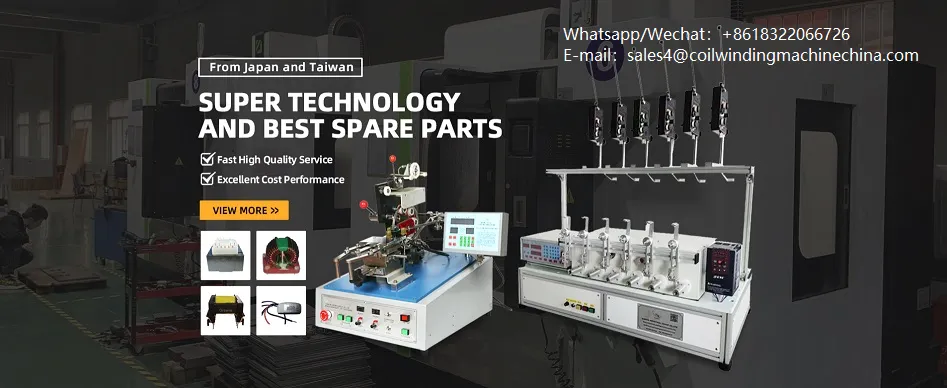
3.3 Flexibility and adaptability
Modern winding machines often support multiple wire sizes (e.g., copper or aluminium), different coil geometries, and different production runs (custom small runs or large volumes). This adaptability is key as transformer designs diversify (for renewable applications, EV chargers, compact electronics). This flexibility is cited as a key advantage: "flexibility is another significant advantage… able to be easily programmed to accommodate different wire sizes, shapes, and materials."
3.4 Real-time monitoring, digital control and lower waste
With the incorporation of digital control systems, servo drives and IoT connectivity, many winding machines now provide real-time oversight of winding tension, turn count, speed, and faults. This enables predictive maintenanc
e and quality assurance. Additionally, machine optimisation contributes to less material waste, better utilisation of wire, fewer rejects, and therefore cost savings. One article outlines cost savings and waste reduction as benefits of modern coil winding machines.
3.5 Suitability for advanced and specialised transformer demands
As transformer requirements become more stringent-higher voltages, compact designs, novel core materials, higher frequencies-the winding machine needs to handle fine tolerances, special insulation materials, precise layering, and complex geometries. Modern winding machines are equipped to meet these demands, enabling manufacturers to respond to market trends (e.g., in renewable energy, EV infrastructure) with high-performance coils. For example, an article states that transformer coil winding machines are "essential equipment in the power industry… high-precision and high-efficiency winding machines have become essential."
4. Market Context and Trends
4.1 Market growth and drivers
The market for coil winding machines (which includes transformer winding machines) is experiencing strong growth. One recent report projects the global coil winding machine market will exceed US$1.18 billion by 2030, with the Asia-Pacific region acting as the core engine of this growth.

Another analysis of the transformer winding machine market projects significant growth, driven by rising electrification, grid upgrades, EV charging infrastructure, renewable energy and manufacturing automation.
4.2 Impact of automation and digitalisation
Automation, robotics, machine learning and IoT connectivity are strongly influencing machine development. An article titled Future of Transformer Winding Machines Guide states that the development of these machines is "closely tied to technological trends that emphasise efficiency, precision, and adaptability."
As manufacturers seek to reduce labour costs, improve uptime and integrate with smart factory infrastructures, the winding machine becomes a node in the digital manufacturing ecosystem.
4.3 Regional dynamics and supply chain issues
The Asia-Pacific region is emerging as a key region for manufacturing and deployment of winding machines, benefiting from supply-chain upgrades, cost advantages and growing domestic transformer production.
On the other hand, supply chain bottlenecks in transformers themselves are causing concern; for example, a large transformer maker warned of a supply crunch due to rising demand and specialised equipment needs.
These supply constraints emphasise the importance of the winding machine subset of the manufacturing chain.
4.4 Innovation trends and sustainability pressures
Machine manufacturers are responding to demand for more sustainable manufacturing - lower material waste, ability to wind aluminium instead of copper, energy-efficient drives, and flexibility for custom coil geometries. For instance, winding machines evolving toward eco-efficiency and flexibility are cited in the future‐oriented article.

5. Key Considerations for Manufacturing and Purchasing
5.1 Match machine capability to coil type and transformer requirements
When selecting a transformer winding machine, the manufacturer must ensure the machine supports the necessary coil geometry (bobbin, toroidal, foil), the correct wire type (copper, aluminium), and the required size and turn count. The winding method (layer winding, helical, traverse) also matters. Mis-match leads to poor quality or inefficiency.
5.2 Automation, control and integration
The level of automation and control in the machine should align with production volumes, product variation and quality targets. A fully automatic machine makes sense for high-volume standardised production, whereas a flexible semi-automatic might suit custom small batches. Integration with factory software, data monitoring, maintenance scheduling, and traceability adds value.
5.3 Precision, repeatability and maintenance
Precision in wire placement, tension control and turn count is essential for transformer performance. Operators should evaluate the machine's feedback loops, servo system, tension control, traversal systems, and whether the machine provides real-time monitoring. Maintenance regimes and spare parts availability are also important to maintain uptime and reduce downtime.
5.4 Flexibility and future-proofing
As transformer designs evolve (for example, for EV chargers, renewables, and higher frequencies), a winding machine needs
to be able to adapt: different wire sizes, materials, new insulation systems, different winding patterns, and changeover ease. Investing in a machine with a modular design or flexible tooling can pay off.
5.5 Cost, ROI and total cost of ownership
Beyond the purchase price, manufacturers need to evaluate the total cost of ownership: maintenance, energy consumption, scrap/waste reduction, labour saving, downtime cost, and production capacity gains. The advantages of precision
and automation (less scrap, higher yield) discussed earlier contribute to ROI.
5.6 Supply-chain and lead-time risks
Given global supply-chain pressures in transformer manufacture and related equipment, manufacturers should consider lead times, machine delivery, spare-parts supply, and risk of obsolescence. The broader transformer supply crunch highlights how delays in one component (including winding machines) may impact production timelines.
6. Challenges and Future Outlook
While transformer winding machines bring many advantages and the market is growing, challenges remain. For example:
The cost of high-end automation and precision machines can be significant, which may restrict adoption in smaller manufacturing setups.
The machine must keep pace with evolving transformer designs (higher voltages, compactness, new materials). This requires ongoing R&D and flexibility.
Supply chain constraints for components (servo drives, sensors, controllers) and for the transformers themselves can delay manufacturing ramp-up.
Workforce training is needed: even a highly automated machine requires skilled technicians for setup, maintenance and integration into digital manufacturing systems.
Looking ahead, the future of transformer winding machines is promising. As one industry insight article summarises, automation, IoT connectivity, and cross-disciplinary innovation will shape the next generation of winding machines.
With the push for decarbonisation, grid modernisation, EV infrastructure and compact power electronics, demand for high-quality, efficient, flexible winding machines will continue to rise.
7. Conclusion
In summary, the transformer winding machine is no longer a simple mechanical device-it is a strategically important manufacturing asset in the electrical industry. With the global push toward renewable energy, electrification, and smarter grids, the machine that winds transformer coils must deliver precision, efficiency, flexibility and digital integration. Whether in large-scale power transformer production or in compact electronic transformer manufacturing, selecting the right category of machine, understanding its advantages, matching it to the production need, and planning for future evolution are key steps. The market is growing, automation is advancing, and manufacturers who adopt the right winding machines will be better positioned to meet tomorrow's transformer demands.


