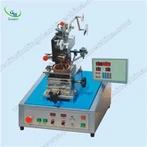
The winding skills of the transformer winding machine must first of all be wound on the wire type characteristics of the object, the number of turns and the appearance of the material, winding speed to be like self-adhesive wire, lacquer coated cotton wire, etc., the set wire diameter to increase a lot, because the skin is not too smooth, less inertial characteristics. The winding speed of thin wire should not be too slow, but it must be started with slow climb to avoid breaking the wire. Thick line speed should not be too fast (overspeed), but must pay attention to the low speed torque is enough. When USING ALUMINUM wire, please note that the expansion force should be much smaller than the copper wire of the same thickness, so as to avoid the wire diameter, the outer insulating paint burst, affecting the quality of the product. When using aluminum wire, the diameter of the wire should be increased due to the decrease of the swelling force. Combined with their need to rise can go a few less.
There is a considerable relationship between the shape of the transformer winding machine and the height and distance of the wire conductor and the speed of the square winding object should not be too fast, there will be a circle convex uneven in the middle, affecting the neat line. The height of the object being wound and the line organizer should be appropriate, too low line is easy to fall into the next layer, too high will have jumper phenomenon. The distance between the conductor and the object being wound should not be too far away, which will affect the accuracy of the coupling. The tightness of the conductor is also related to the beauty of the winding and routing. The first priority is to calibrate the width of the object to be wound and the starting point of winding, and Z is important. When the starting point is correct, start winding, you can stop at both ends to test whether the width set is correct.
When starting WINDING, whether beautiful or not, the starting point is too far ahead or too far behind (no vertical phenomenon between the exit and the object being wound). The wire is too thin or too dense (the wire diameter is not set correctly). Both ENDS TURN TOO FAST OR TOO SLOW (INCORRECT WIDTH SETTING: TOO FAST = NOT ENOUGH WIDTH, TOO SLOW = TOO WIDE). Whether the wiring is getting faster or slower with the coupling (fine-tune the wire size again: faster = smaller, slower = larger). Pay attention to the coupling of the wiring after winding several layers. The object is deformed by winding multiple layers. The MARKED WIRE DIAMETER OF ENAMELED WIRE IS THE ACTUAL WIRE diameter, SO THE THICKNESS OF THE ENAMELED WIRE MUST BE ADDED when SETTING THE WIRE diameter. After the winding is completed, the resetting (displacement) of the conductor is also affected. Thin winding row, start winding point Z better forward, width Z better reduced. Jump grid winding, generally can be overcome in the setting way.